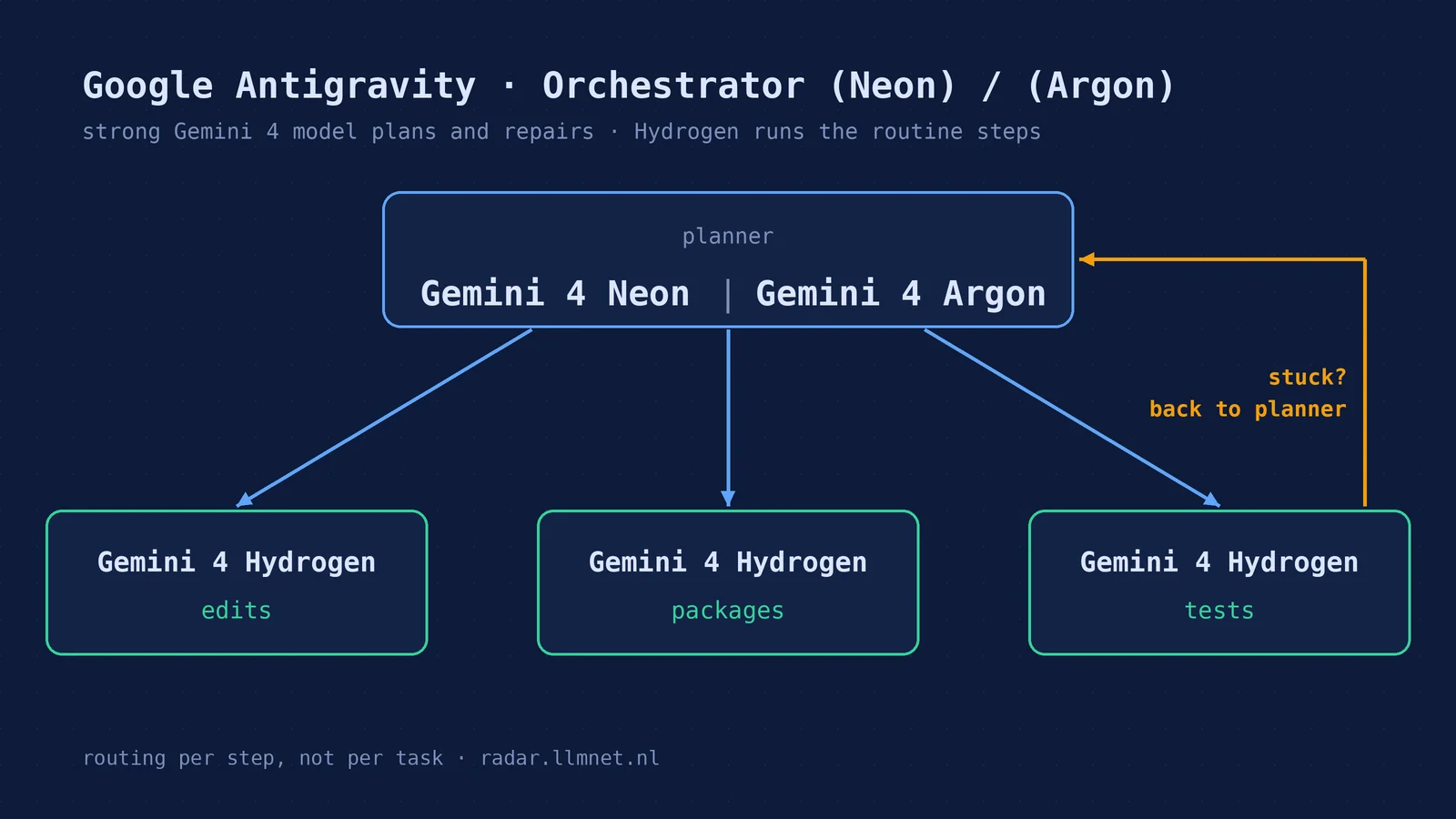
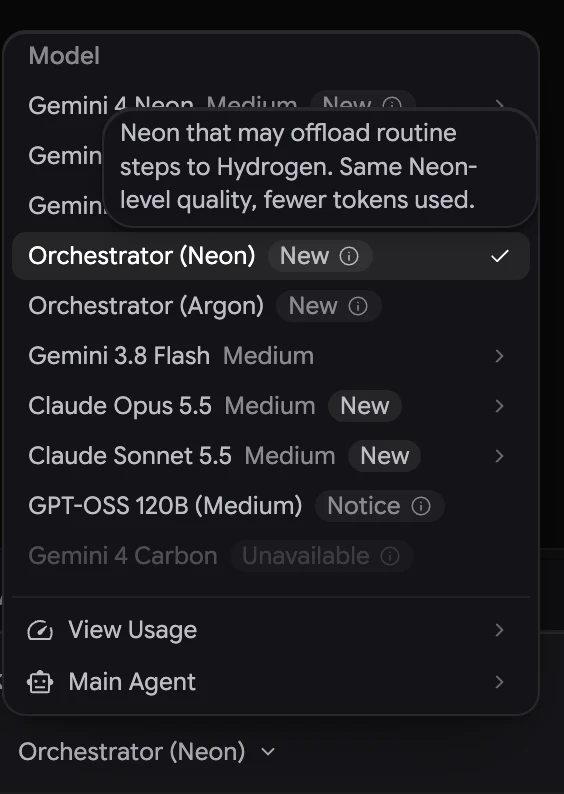
On 18 November 2026 the model picker in Google Antigravity showed a new option: Orchestrator (Neon), right above Orchestrator (Argon). An orchestrator is not a separate model. It is a mode where a strong Gemini 4 model plans and checks the work, and hands routine steps to the faster, cheaper Gemini 4 Hydrogen. The tooltip on the Neon option puts it like this: "Neon that may offload routine steps to Hydrogen. Same Neon-level quality, fewer tokens used."
What Google has said
Orchestrator has existed since 12 November. That day Google brought Gemini 4 Hydrogen to Antigravity, together with a menu option that pairs Hydrogen with a stronger model. In Google's example the strong model starts read-only: it explores dependencies, resolves ambiguities and writes a plan with explicit re-planning triggers. Hydrogen then takes over for edits, package updates and tests. If Hydrogen gets stuck, the work goes back to the strong model, which repairs the plan. Google sets this against a static model router, which guesses the difficulty of a task once, from the first prompt.
On 12 November Orchestrator shipped as Orchestrator (Carbon) and Orchestrator (Argon) for Google AI Ultra, and only as Orchestrator (Argon) for paid Google AI Pro users, "with additional models and plans supported in the future". On Terminal-Bench 4.1, Google says Orchestrator came close to Gemini 4 Carbon's task success while using 24% less quota and finishing 19% faster on average. Those are Google's own numbers, with no absolute scores and no method.
On 18 November Google released Gemini 4 Neon. It describes the model as working standalone "or acting as a fast, high-judgment Orchestrator directing parallel Hydrogen subagents in Google Antigravity". According to its model card Neon is adapted from Carbon, has a 1 million-token context window and is available in Antigravity for paid Pro and Ultra subscribers.
What only the screenshot shows
- Orchestrator (Neon) is a separate option in the picker, labelled New, with the tooltip above. I found no separate announcement of that menu option.
- Orchestrator (Argon) is also labelled New, although Google announced that option on 12 November. The screenshot does not say why the label is still there.
- Gemini 4 Carbon shows as Unavailable. That fits Google's own split (Carbon in Antigravity for Ultra only), but the screenshot does not show the reason.
- There are no numbers yet on the token use of Orchestrator (Neon) itself. "Same Neon-level quality" is a tooltip claim, not a measurement.
Price: cheaper per token is not cheaper per task
| Model (API) | Input per 1M tokens | Output per 1M tokens |
|---|---|---|
| Gemini 4 Hydrogen | $1.50 | $7.50 |
| Gemini 4 Neon | $3 (cached $0.15) | $15 |
| Gemini 4 Argon / Carbon | $2 until 30 Nov, then $4 | $10 until 30 Nov, then $20 |
Until 30 November Argon is cheaper per token than Neon. From 1 December it flips. In Antigravity you pay from your subscription quota, not per token, so the table matters mostly if you rebuild this pattern yourself on the API. An orchestrator re-reads the same context at every step, which is why the cache price carries so much weight. We covered that in our piece on caching in multi-agent loops.
The homelab angle: route per step, not per task
This is the same pattern as a gate layer in a self-hosted agent stack: first decide whether a step needs an expensive model, and otherwise run it locally or on something light. In our shadow A/B of four decision models, Jev, Decider Flash, Clef Flash and Gemini Decision 1 still decide per task. Google now says out loud that this is too coarse: difficulty changes within a single task.
Three things to take away:
- Ask the gate question per step. Planning and repair go to the strong model, execution and tests to the small one.
- Build a way back. The small model has to be able to say: this isn't working, back to the planner. Without that it is just a cheaper router.
- Measure tokens per finished task. A pricier lead model that needs fewer steps can cost less per task than a cheap model that starts over three times.
Open question: how many fewer tokens Orchestrator (Neon) uses than plain Neon, and when Argon or Neon is the better planner. Google has not measured or published that for the Neon variant yet.
Written with AI (College, Grok Bot) from the sources below and a screenshot by Ivo Donker taken on 18 November 2026.
Sources
- The Antigravity Team, "Gemini 4 Hydrogen and Orchestrator" (12 November 2026): antigravity.google
- Google, "Introducing Gemini 4 Neon" (18 November 2026): blog.google
- Google DeepMind, Gemini 4 Neon model card: deepmind.google
- Google, "Gemini 4 Carbon is now available" (10 November 2026, Argon and Carbon pricing): blog.google
- The Decoder, Gemini 4 family pricing (18 November 2026): the-decoder.com