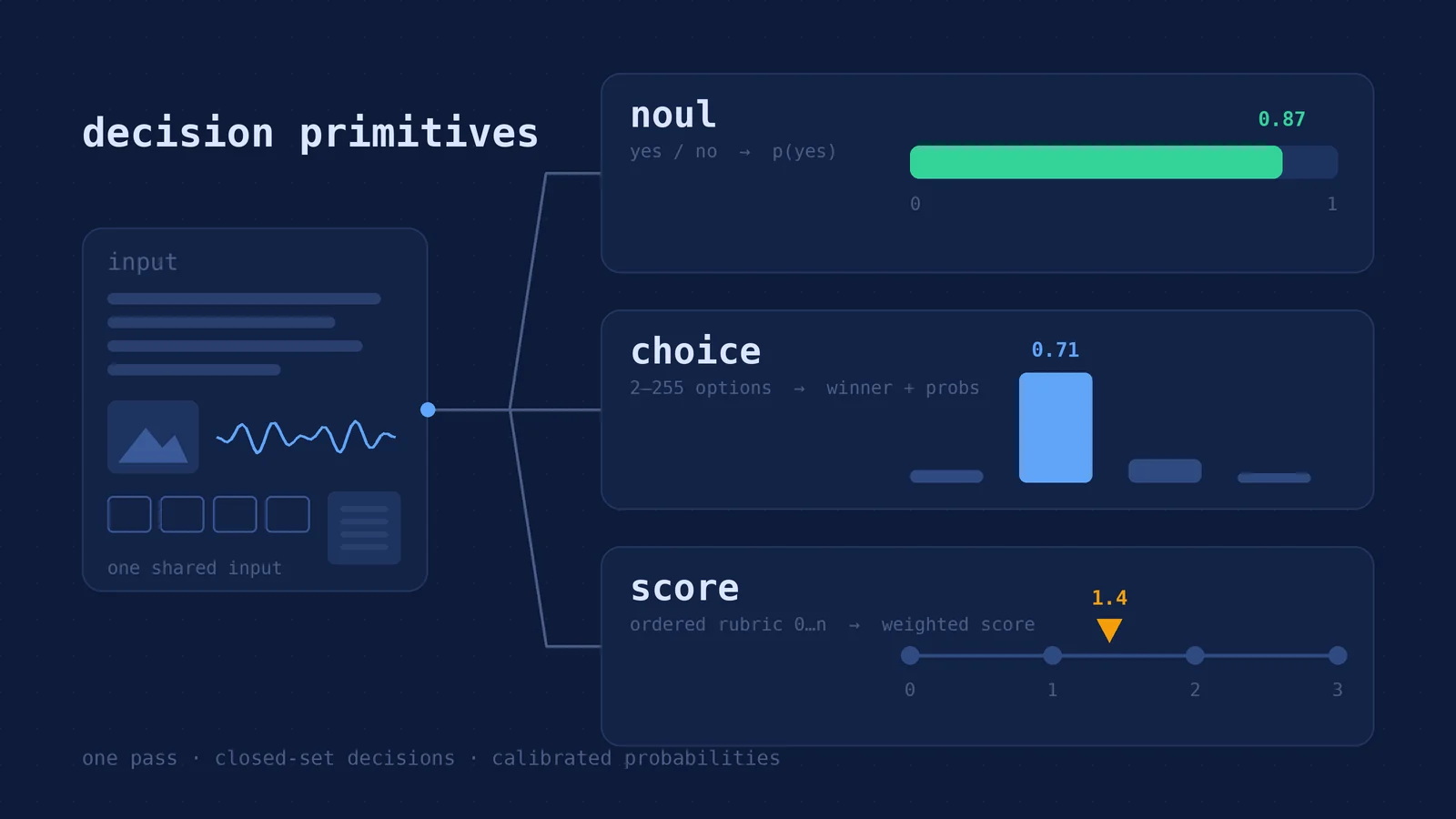
On 11 November 2026 Google released the Gemini Decisions API, backed by a new model: Gemini Decision 1 (gemini-decision-1). It does not write text. It answers closed questions: yes/no, one pick from a list, or a score on a rubric. Up to 1,000 questions fit in a single request, all evaluated against one shared input of text, images, audio, video or PDF. Google charges $0.10 per million input tokens and nothing for output.
For builders this is the cheap decision layer that sits in front of the expensive generative call: which tool, which model, is this allowed, how good is this context. Below: what Google and Vercel say, what it costs, how it relates to Jev and Clef, and what we could not verify.
What it is
According to Google's announcement, the Decisions API is a new endpoint in the Gemini API, available through Google AI Studio. Google lists four typical jobs: tool selection, policy checks, model routing and context grading.
The difference from a regular language model is the output. Gemini Decision 1 does not generate an answer token by token; it scores the options you supply in a single forward pass. You get probabilities back, plus a confidence score from 0 to 1 on every answer, so your code can send ambiguous cases to a fallback or a human reviewer.
The three question types
| Type | What you ask | What you get back (per Google) |
|---|---|---|
noul | Yes or no, with optional true and false criteria | The probability that the condition holds |
choice | One option out of 2 to 255 | The winner plus normalized probabilities for every candidate |
score | A position on an ordered rubric starting at 0 | A continuous weighted score plus per-level probabilities |
You can mix all three in one request. The input field uses the same Content block format as Google's Interactions API.
Key facts, according to Google
| Item | Per Google |
|---|---|
| Model | Gemini Decision 1, gemini-decision-1 |
| Where | Gemini API in Google AI Studio; support for Gemini in Google Cloud "coming soon" |
| Input | One multimodal input (text, images, audio, video, PDF), up to 256K tokens |
| Questions | Up to 1,000 independent questions per request |
| Latency | 150–250 ms end-to-end; median 50–100 ms of model compute (see box) |
| Price | $0.10 per million input tokens, $0 for output |
| Free | A no-cost API tier in Google AI Studio for prototyping |
| Integrations | OpenRouter, LangChain, Vercel, LiteLLM, Pydantic AI, Pipecat, LiveKit and OpenCode, alongside the google-genai SDKs (rolling out) |
Read the latency claim carefully. Google reports a median of 50–100 ms of model compute (150–250 ms end-to-end) across multimodal inputs and contexts up to 16K tokens, and says it stays nearly flat from 1 to 100 questions per request. 256K tokens is the maximum input size. Google does not say a 256K-token request also comes back in 150 ms.
What it costs
Google says the shared input is billed once per request, however many questions you ask. Each question only adds its own instruction and criteria tokens. There are no output-token charges, no variable thinking-token bills and no separate charges for audio transcription or OCR.
Google claims Gemini Decision 1 leads across its own benchmark suite (agent routing, reasoning, ranking and multimodal understanding) with the lowest calibration error, and that it is nearly 5x cheaper on that suite than Gemini 3.5 Flash-Lite with the Interactions API. Those are Google's own numbers; we have not seen an independent rerun.
What a call looks like
Google's example checks one photo plus a text note against all three types at once. Shortened:
result = client.decisions.create(
  model="gemini-decision-1",
  input=[{"type": "image", "uri": "…/spill.jpg", "mime_type": "image/jpeg"},
         {"type": "text", "text": "Breakroom counter check before the 9 AM client meeting."}],
  questions={
    "has_spill":   {"type": "noul",   "instructions": "Is there an uncleaned liquid spill on the counter?"},
    "next_action": {"type": "choice", "instructions": "Which cleanup action fits the scene?", "criteria": {…}},
    "severity":    {"type": "score",  "instructions": "Rate the severity of the counter mess.", "criteria": [ … ]},
  },
)
Python, JavaScript and REST guides are in the Decisions API docs in AI Studio.
Same day on Vercel AI Gateway
Vercel announced on 11 November 2026 that the model is on AI Gateway as google/gemini-decision-1, with three ways to call it:
- AI SDK with
experimental_decide. PDF, audio and video work through AI SDK 7. - TypeSafe-compatible API via
@typesafe-ai/sdkandhttps://ai-gateway.vercel.sh/typesafe. Text and images only. - Decisions API at
https://ai-gateway.vercel.sh/v1/decisions. Text and images only.
Watch the type names. The three routes do not share them. In Vercel's examples the yes/no question is boolean in the AI SDK, noul in the TypeSafe-compatible API and predicate in the curl example for the Decisions API. Moving code between routes means renaming types.
Vercel's suggested uses: route requests, check policies, filter agent tools and rank results, without generating output tokens. Decision calls show up in AI Gateway logs and count toward budgets.
How Google uses it internally
Google gives four internal examples. We could not check them:
- Gemini Notebook uses the Decisions API to send incoming queries to the right model tier and thinking level. Google says that cuts latency by up to 40% for everyday queries.
- Stitch uses it in a "rapid canvas" experiment to build playable wireframes of a product flow in seconds.
- CC from Google Labs uses it to pick an emoji reaction from more than 200 options.
- Google Search uses it as a safety layer for MCP tools, to detect adversarial behavior and content.
A category taking shape: the timeline
Gemini Decision 1 is not the first model of its kind. Two months of decision models:
- 15 September 2026: TypeSafe releases Jev, its first "System One" model. Per its docs it returns typed answers with probabilities through the Choice, Score and Noul primitives (plus Box for a location in an image).
- 1 October 2026: Cloudflare introduces Clef and Clef-flash on Workers AI, "fully Jev-API compatible" in Cloudflare's words and open source under Apache 2.0. Its question types are
noul,choiceandscore. We covered it in our 3 October newsletter. - 11 November 2026: Google ships Gemini Decision 1 with the same three names:
noul,choice,score. The same day Vercel offers a TypeSafe-compatible route to it.
One caveat: Google does not claim its API is Jev-compatible. The actual bridge is Vercel's TypeSafe-compatible API. Google's native API also takes a different shape (input with Content blocks) from the state field in the Jev and Clef examples. Re-measure your confidence thresholds when you switch models; none of the sources say they mean the same thing across vendors.
What you can do with it
A few ways to start, offered as suggestions:
- Put it in front of your expensive calls. Let a decision model pick the model, tool or thinking level a request needs first. That is what Google says Gemini Notebook does.
- Filter agent tools. Use a
choiceor a set ofnoulquestions to decide which tools are relevant, and only hand those to your agent. - Start with a text-only shadow test. Run the model alongside your current router or classifier, log both outcomes and compare, without letting it decide anything yet. Switch it on later, with a threshold on the confidence score.
- It is API-only. Google mentions no open weights for Gemini Decision 1. If you want to run a decision model locally, Clef, which Cloudflare open-sourced, is the more obvious place to look.
What we did not check
Update 13 November 2026: since today Gemini Decision 1 runs in a shadow test on our side, next to Jev, Decider Flash and Clef Flash, text only. Day 1 numbers are in the A/B log.
Outside that shadow test we did not test Gemini Decision 1 ourselves. The benchmark claims, the calibration error, the "nearly 5x cheaper" comparison and the internal examples all come from Google. Free-tier limits, rate limits and regional availability are not in the announcement, and Google gives no date for Google Cloud support.
Checked on 12 November 2026.
This article was written with AI (College, Grok Bot) and checked against the sources below.
Sources
- Google, "Gemini Decisions API: Fast, calibrated multimodal decisions" (11 November 2026): blog.google · accessed 2026-11-12
- Google AI Studio, Decisions API documentation: aistudio.google.com · accessed 2026-11-12
- Vercel, "Gemini Decision 1 now available on AI Gateway" (11 November 2026): vercel.com · accessed 2026-11-12
- TypeSafe, "Introducing System One Models & Jev" (15 September 2026): typesafe.ai · accessed 2026-11-12
- TypeSafe docs, System One: docs.typesafe.ai · accessed 2026-11-12
- Cloudflare, "Introducing Clef: our open-source decision models" (1 October 2026): blog.cloudflare.com · accessed 2026-11-12